Share


Software Release Life Cycle Explained Thoroughly

- BLOG
- Software Development
- December 8, 2025
What feels like a seamless, stable piece of software to you is actually the result of a carefully engineered journey called the Software Release Life Cycle. This cycle exists because software does not become reliable by chance.
Each stage strengthens the version that comes after it, revealing issues early and confirming readiness before real users ever see it. When this structure is followed well, your team gains clarity, stability and predictable release outcomes.
Understanding how this cycle works is valuable, and this article walks you through each stage. You will see why these checkpoints matter and how they help you build dependable, high-quality software with greater confidence.
Contents
- 1 What Is the Software Release Life Cycle?
- 2 Software Release Life Cycle vs Software Development Life Cycle
- 3 Key Stages of the Software Release Life Cycle
- 4 Software Release Types
- 5 Build reliable software releases with Webisoft’s expert guidance.
- 6 Why a Structured Release Life Cycle Matters
- 7 Deployment Strategies Used During Software Releases
- 8 Best Practices for a Strong Software Release Life Cycle
- 9 Common Challenges & Failures in the Software Release Life Cycle
- 10 How Webisoft Executes a Professional, High-Quality Release Life Cycle
- 11 Build reliable software releases with Webisoft’s expert guidance.
- 12 Conclusion
- 13 Frequently Asked Questions
What Is the Software Release Life Cycle?
The Software Release Life Cycle is the structured process by which software moves from development to end users and continues through maintenance and updates. It defines the checkpoints, assessments, and validation steps required before any version becomes available to users.
Using this lifecycle ensures that every release is methodically planned, tested, validated and deployed. It helps teams catch defects early, align releases with quality and performance standards and manage versioning and maintenance over time.
For you, whether you are a developer, project manager or stakeholder, SRLC offers a dependable roadmap that balances speed, reliability and control. Following it helps ensure predictable delivery of stable, maintainable software.
Software Release Life Cycle vs Software Development Life Cycle
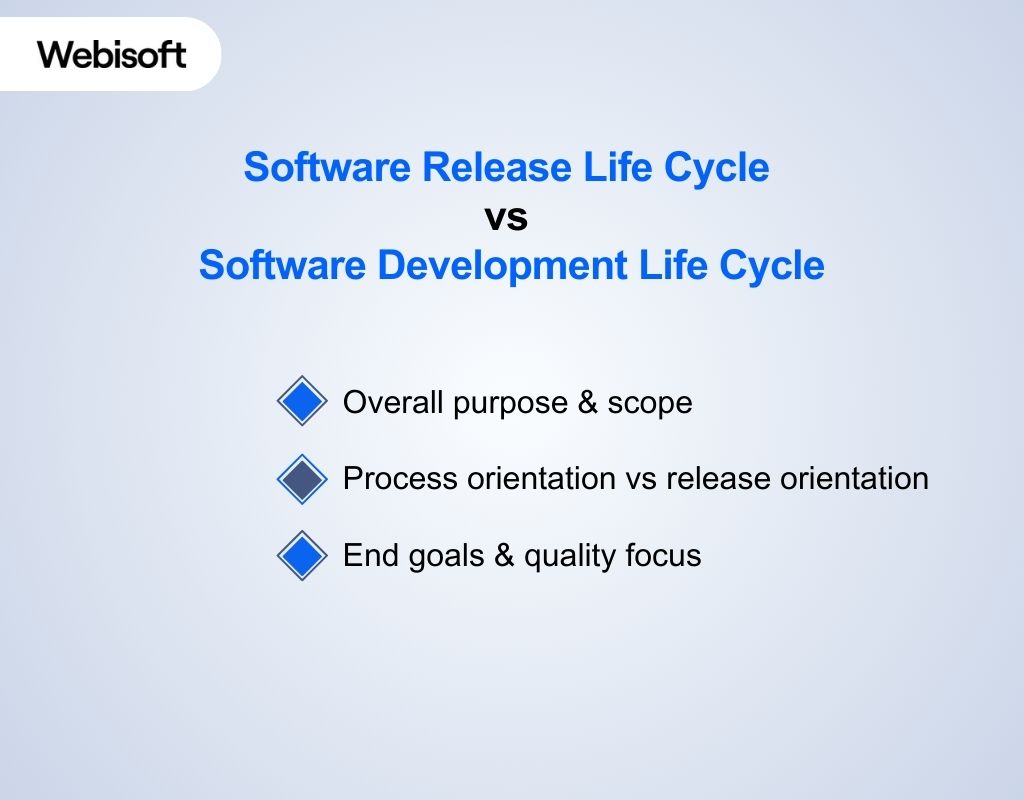 It is easy to mix up the Software Release Life Cycle (SRLC) with the Software Development Life Cycle (SDLC). These two frameworks serve different goals, and this comparison helps you understand how each one operates.
Overall purpose & scope
- SRLC: Focuses on what happens after development: how builds are validated, versioned, released to users and maintained over time.
- SDLC: Covers the full journey of software creation: planning, design, coding, testing, deployment, and maintenance. For example, building the software from concept to delivery, as outlined in comparative studies of SDLC models.
Process orientation vs release orientation
- SRLC: Oriented around release readiness, validation, packaging, distribution, updates and support lifecycle of product versions.
- SDLC: Oriented around structured development phases: requirement analysis, design, implementation, testing to create a working software product.
End goals & quality focus
- SRLC: Aims to ensure that each released version is stable, tested, user-ready, with proper support, updates, and version management in place.
- SDLC: Aims to deliver a software product that meets requirements, is functional, maintainable, and meets quality, cost, and schedule constraints.
Key Stages of the Software Release Life Cycle
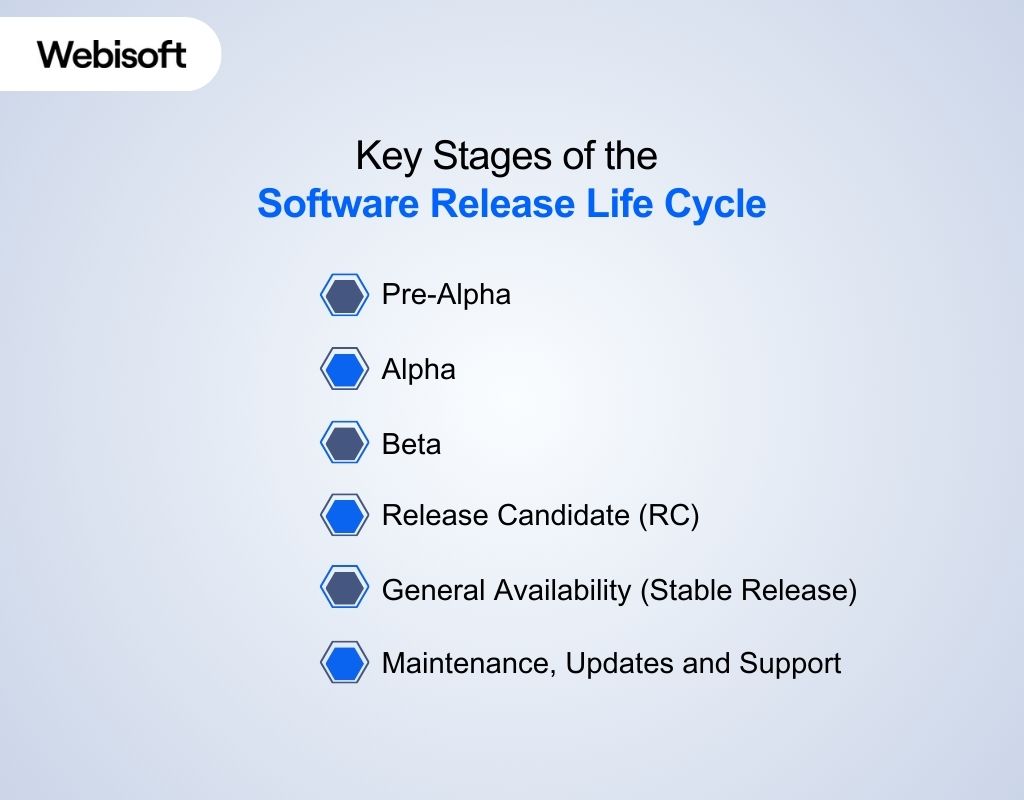 A software release moves through several organized stages that shape how each version matures. Understanding these stages helps you manage quality, identify readiness and support predictable delivery throughout the release cycle.
Pre-Alpha
The Pre-Alpha stage builds the foundation for all later release activity. Here, the team shapes core architecture, reviews early requirement details and creates initial prototypes or working components.
This stage forms the basis for the upcoming software release stages alpha beta, where testing becomes more structured. Pre-Alpha does not involve broad testing, but it sets the direction for stability and feasibility. Any design flaws or requirement gaps discovered here can create lasting issues in later phases, so this stage focuses on alignment, clarity and early technical validation.
Alpha
The Alpha stage introduces structured internal testing. Developers and QA teams begin validating early functionality, identifying logic issues and checking integration points. This stage represents the first half of the software release stages alpha, beta, which define the early maturity levels of a build.
Alpha aims to reach feature completeness. Once primary functions behave consistently and major bugs are addressed, the build becomes stable enough to exit Alpha. This phase highlights architectural gaps or large defects that must be resolved before external feedback begins.
Beta
The Beta stage introduces the software to external testers or selected user groups. This exposure reveals issues linked to real environments, varied devices and genuine user behavior, which internal testing cannot fully simulate.
At this point, teams often review what comes after beta testing, because the feedback gathered here directly prepares the build for the Release Candidate stage. During Beta, the software must be feature complete and stable enough for broad evaluation.
External input at this stage helps refine usability, performance and compatibility, allowing teams to improve the build before it moves toward final verification. The adjustments made in Beta play an essential role in ensuring smoother progression into the next release checkpoint.
Release Candidate (RC)
A Release Candidate is a version that could become the final public release if no unresolved issues emerge. This stage includes regression testing, integration checks, documentation review and performance validation.
Teams treat RC as a near-final build and verify that it meets all release criteria. If the RC passes all checks, it is approved for general availability. If issues appear, fixes are applied and a new RC may be produced. This stage ensures readiness before the software reaches all users.
General Availability (Stable Release)
General Availability marks the official public release of the software. You may see this described as GA meaning in software release, which refers to a stable version made available to all intended users.
At this stage, the build is deployed to production systems, documentation is finalized and support plans are active. GA represents the point where the software is considered reliable enough for live environments and long-term adoption.
Maintenance, Updates, and Support
After the software reaches GA, the release cycle continues through ongoing maintenance. Teams fix defects, address security issues, release patches and refine features based on real-world usage. This stage maintains long-term reliability and performance after the initial release.
Maintenance also helps prevent regression issues and ensures the software remains compatible as environments evolve, a process explored further in this software maintenance guide. Structured maintenance supports user satisfaction and reduces long-term risks.
Software Release Types
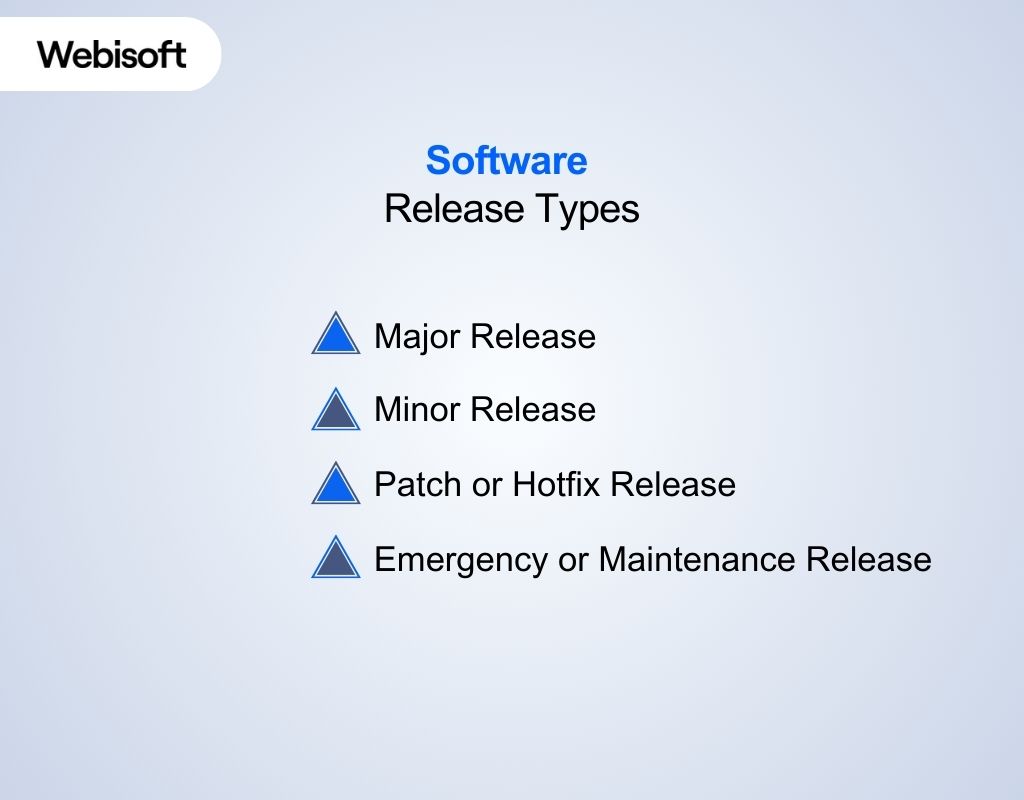 Not every release serves the same purpose or carries the same impact. Understanding key software release types helps you plan updates intentionally, support users effectively and maintain a predictable release rhythm across your product lifecycle.
Major Release
A major release introduces substantial changes such as new features, architectural updates or compatibility shifts. These releases often update the primary version number and require coordinated testing and communication because they can reshape functionality, user experience and long-term product direction.
Minor Release
A minor release adds enhancements or smaller features without disrupting existing functionality. It is designed to improve the product incrementally and appears as a mid-level version update. Teams use minor releases to introduce value safely between larger development cycles.
Patch or Hotfix Release
Patch releases address bugs, performance issues or security vulnerabilities. They focus on stability rather than new functionality. Hotfixes, a more urgent form of patching, resolve critical issues quickly and often require rapid but careful testing to avoid new regressions.
Emergency or Maintenance Release
Emergency or maintenance releases respond to unexpected failures, compliance requirements or high-priority defects. They emphasize restoring system stability and may follow an accelerated path. Even with time pressure, teams validate changes thoroughly to protect reliability in production.


Build reliable software releases with Webisoft’s expert guidance.
Get structured support for planning, testing and deploying every release consistently.
Why a Structured Release Life Cycle Matters
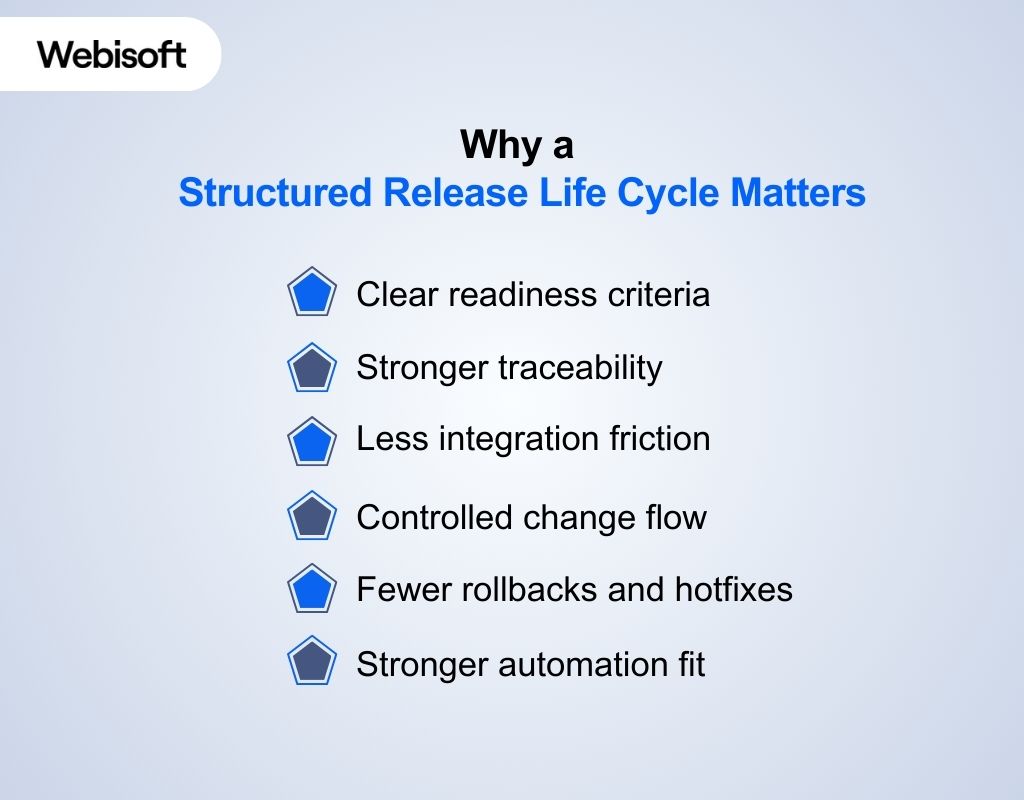 Now that you understand the key stages of the software release cycle, it is important to see why structure matters. A defined framework keeps your releases controlled, predictable and aligned with technical and operational requirements.
Clear readiness criteria
A structured release cycle gives you documented criteria to decide when a build can progress. Stability checks, performance benchmarks and validation steps prevent premature movement into later stages, which reduces the chance of inherited defects.
Stronger traceability
With a defined cycle, every build is tracked as it moves from development to production. This improves auditability, supports regression analysis and helps teams identify where defects originate. It also ensures consistent behavior across environments.
Less integration friction
Complex projects include parallel work across development, QA and operations. A structured cycle sets expectations for stability, documentation and testing depth before handoffs. This alignment reduces blockers that slow releases in multi-team workflows.
Controlled change flow
Defined stages help you manage dependencies that affect APIs, modules or external services. By regulating when changes enter the pipeline, you avoid unpredictable behavior and compatibility issues that create instability in later phases.
Fewer rollbacks and hotfixes
Structured validation reduces the need for emergency fixes. Issues are identified earlier through internal and external checks, which lowers the risk of flawed builds reaching production. This leads to fewer disruptions and a more reliable release history.
Stronger automation fit
Automation works best when the release process is predictable. A structured cycle provides the sequence and rules that CI pipelines rely on. This consistency improves automated testing, build promotion, and deployment reliability.
Deployment Strategies Used During Software Releases
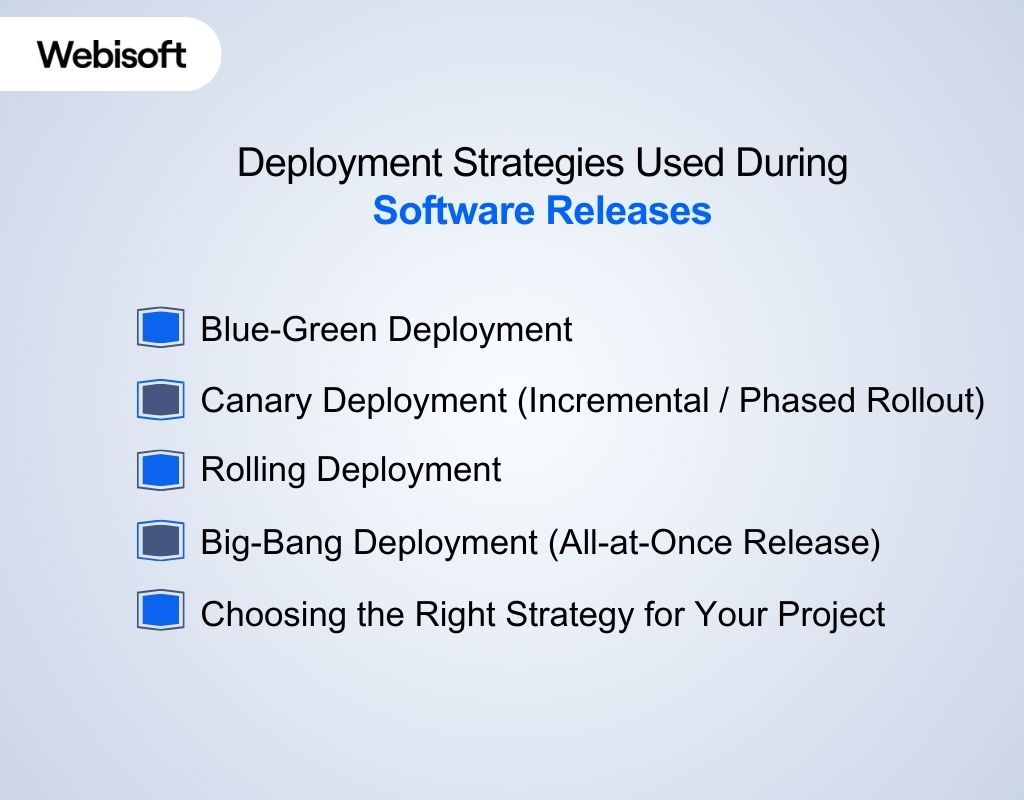 When you move software from development into production, the way you deploy can make or break user experience. A proper deployment strategy helps you release updates smoothly, minimize downtime, and manage risk intelligently across environments.
Blue-Green Deployment
In Blue-Green deployment, you maintain two identical production environments, one active (Blue) and one idle (Green). You deploy the new version to the idle environment, test it thoroughly, and then switch traffic from Blue to Green once you are confident in stability.
This approach offers nearly instant rollback: if anything goes wrong after the switch, you revert to the previous environment quickly. It minimizes downtime for users and ensures safer, controlled release of major updates.
Canary Deployment (Incremental / Phased Rollout)
Canary deployment releases the new version gradually, initially to a small subset of users or servers, then incrementally to the rest. This lets you monitor performance, user feedback, and error rates before exposing the update to everyone.
If any issue arises during the limited rollout, the impact is contained, and you can pause or roll back without affecting the entire user base. This minimizes risk and helps catch unexpected problems before full release.
Rolling Deployment
Rolling deployment updates the software in increments across servers or instances rather than all at once. Over a series of steps, parts of the infrastructure are updated while others remain live, gradually replacing old code without downtime.
This is effective for continuous delivery / continuous deployment (CD) environments and operations that cannot afford downtime. Because updates happen gradually, risk is spread, making failures easier to isolate and manage.
Big-Bang Deployment (All-at-Once Release)
Big-Bang deployment pushes all changes to production at once; all new features, fixes, and updates go live together. While simple in planning, this method carries a high risk: if something goes wrong, it may affect many users, and rollback can be complex. It’s suitable only for small updates or non-critical systems where downtime is acceptable.
Choosing the Right Strategy for Your Project
Selecting a deployment strategy depends on factors like application complexity, user base size, tolerance for downtime, and available infrastructure. For mission-critical or high-availability applications, Blue-Green or Canary is often preferred for safety.
For continuous release environments or frequent updates, Rolling deployment may offer the right balance of speed and reliability. Big-Bang is usually reserved for small, low-risk updates.
Best Practices for a Strong Software Release Life Cycle
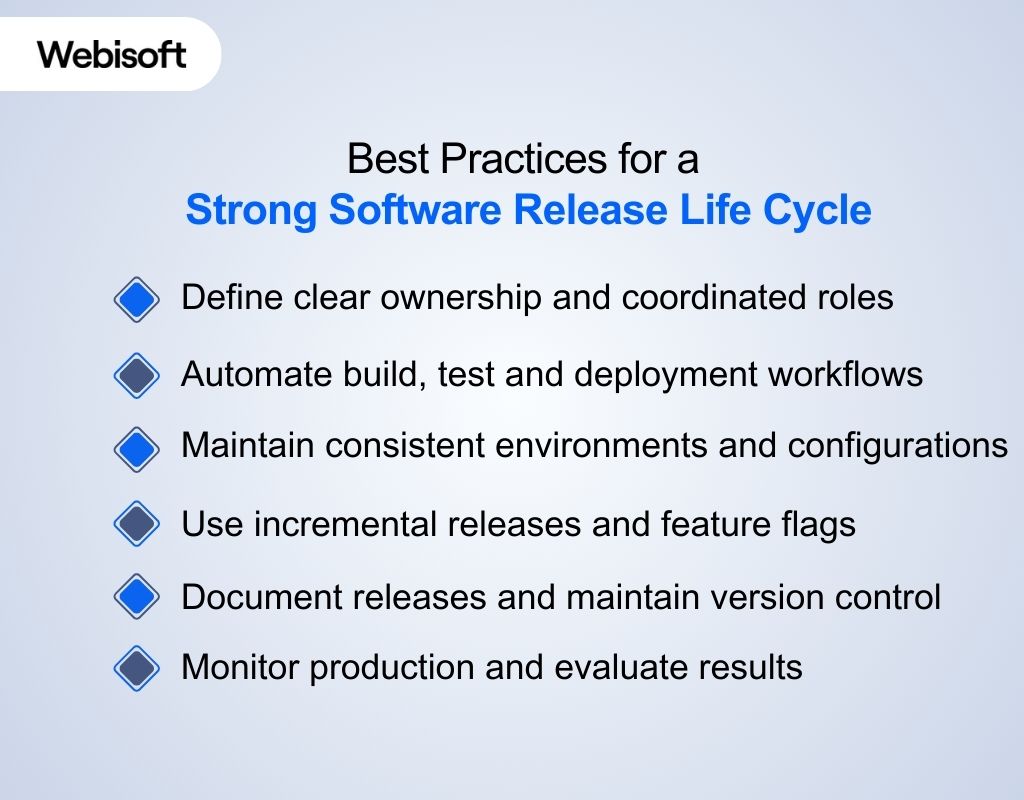 A strong release life cycle depends on practices that support consistency and technical reliability. These methods help you manage complexity, reduce risk and move every release through controlled, predictable stages.
Define clear ownership and coordinated roles
Assigning ownership for development, testing, and deployment ensures accountability at every stage. When responsibilities are defined, teams avoid conflicting priorities and unnecessary delays. Coordinated release calendars, dependency tracking, and communication channels help everyone stay aligned as versions progress.
Automate build, test, and deployment workflows
Automation makes releases more reliable by applying the same checks to every change, supported by choosing effective software development tools. Automated builds and regression tests catch issues early, while CI and CD pipelines maintain consistency across environments. This reduces human error and speeds up your release rhythm.
Maintain consistent environments and configurations
Stable environments reduce release failures. Keeping development, staging and production aligned helps ensure builds behave the same throughout the cycle. Version-controlled configuration and dependency validation prevent issues that only appear after deployment.
Use incremental releases and feature flags
Incremental updates reduce the impact of unexpected issues. Feature flags let you enable or disable new functionality without redeploying, giving you safer control during rollout. These methods help limit risk when introducing changes into real environments.
Document releases and maintain version control
Accurate documentation supports predictable releases. Notes about changes, deployment steps, rollback paths and known issues help teams understand what each version includes. Version control for code and configuration creates traceability that makes maintenance and auditing easier.
Monitor production and evaluate results
Post-release monitoring reveals how software behaves in real usage conditions. Tracking performance, errors and user feedback helps you refine upcoming releases. Release metrics also support long-term process improvements and better decision-making. If you want these best practices applied with consistency and technical depth, Webisoft can help shape a release flow that actually works in real conditions. Reach out now!
Common Challenges & Failures in the Software Release Life Cycle
 Even structured release cycles face challenges that can disrupt delivery. Recognizing these issues early helps you reduce risk, improve coordination and protect the stability of each release.
Inconsistent build quality and rushed releases
Rushed timelines often lead to incomplete testing and unstable builds. This makes defects harder to manage in later stages and increases the chance of failures in production. Several release-management studies, including industry research on release management challenges, cite poor build quality as a frequent cause of deployment issues.
Poor visibility and weak cross-team coordination
When development, QA and operations lack clarity on scope, dependencies or status, releases slow down. Miscommunication creates conflicting changes and missed checks, which are common triggers for release delays and post-deployment problems.
Environment and configuration mismatches
A build may pass testing but fail in production if environments differ in configuration, dependencies or integrations. Without environment parity, software behaves unpredictably, leading to performance issues, failed deployments or emergency fixes.
Insufficient testing depth
Focusing only on functional tests often leaves performance, security or edge-case issues undiscovered. Missing these checks increases the likelihood of failures under real-world conditions, especially during load spikes or integration-heavy scenarios.
How Webisoft Executes a Professional, High-Quality Release Life Cycle
 A strong release life cycle only works when backed by disciplined execution. This is where Webisoft becomes your advantage by combining structured engineering practices with practical product expertise to guide each software version from development to deployment.
End-to-end ownership from concept to release
Webisoft handles your entire product journey, starting with research, scoping and early prototypes, and continuing through development, testing and deployment. This unified approach removes handoff friction and ensures every stage stays aligned with your goals.
Our software release process gives you one accountable team managing both the build and the release path, keeping progress predictable and transparent.
Structured QA that protects release stability
Quality assurance is treated as a core pillar rather than an afterthought. Webisoft runs systematic functional, integration and performance checks before any build moves forward. This reduces defects early and strengthens the reliability of each release.
You get software that behaves consistently across environments, supported by expertise in enterprise software development that validates stability long before you reach production.
Architecture and technology choices built for growth
We design products with scalability in mind, selecting frameworks, databases and cloud setups that support long-term evolution. This ensures your release cycle is not slowed down by architectural limits. By planning for scale from the beginning, your software can adapt to higher load, new features and changing market needs without destabilizing future releases.
Continuous support after launch
Your product does not stop moving once it goes live, and neither does Webisoft. The team provides ongoing updates, patches, monitoring and feature enhancements to keep your software secure and competitive. This post-release support gives your release cycle durability, helping you maintain quality across versions while preparing for future improvements.
Flexible delivery models customized to your product needs
Webisoft adapts to your stage and structure. Whether you need a full build, an MVP, a micro-SaaS development strategy, a modernization of an existing application or long-term engineering support. This flexibility helps you maintain a release rhythm that fits your business, avoiding bottlenecks while ensuring each release meets the same high standards.
Build reliable software releases with Webisoft’s expert guidance.
Get structured support for planning, testing and deploying every release consistently.
Conclusion
A well-managed Software Release Life Cycle brings the entire development journey full circle. It ties together planning, testing and deployment into a structured flow that helps you deliver software that feels stable, thoughtful and ready for real users.
With this understanding, you can move forward with greater confidence in every release. And when you want a partner who can support that process with precision and expertise, Webisoft is ready to help you bring your product to its strongest finish.
Frequently Asked Questions
Can a product stay in Beta for a long time?
Yes. Some products remain in Beta for extended periods when teams want ongoing feedback, need real-world usage data or release frequent updates. Long Beta cycles help refine usability, stability and performance before committing to a formal production release.
Do all software teams use the same release stages?
No. Release stages vary based on team structure, product complexity, development methodology and industry requirements. Many teams adapt or rename stages to match their workflow, especially when using Agile, DevOps, or continuous delivery models that encourage flexible release structures.
Is it possible to skip the Release Candidate stage?
Yes, but it increases risk. Skipping the Release Candidate stage removes the final opportunity to validate stability, integration and documentation before launch. Without this checkpoint, defects are more likely to reach production, leading to emergency fixes or unplanned rollbacks after release.
