Share


How to Create a Smart Contract From Idea to Deployment

- BLOG
- Blockchain
- October 10, 2025
Most people first hear about blockchain and imagine a maze of cryptic code and futuristic finance. But learning how to create a smart contract is far less mysterious once you understand how they work. These digital agreements simply do exactly what you tell them, sometimes a little too literally.
Unlike traditional contracts, smart contracts never misplace documents, negotiate deadlines, or interpret clauses “creatively.” They follow your rules with unwavering precision, which is why developers quickly learn that clarity in code matters as much as clarity in legal text.
In this guide, you’ll move from concept to creation as you learn how smart contracts work, what tools you need, and how to build one step-by-step.
Contents
- 1 What is a Smart Contract?
- 2 How Smart Contracts Work
- 3 The Architectural Blueprints of Smart Contracts
- 4 Functional Types of Smart Contracts in the Modern Economy
- 5 Build secure smart contracts with Webisoft today!
- 6 Blockchains That Support Smart Contract Creation and How They Differ
- 7 Programming Languages Used to Create Smart Contracts
- 8 Tools You Need Before You Start Creating a Smart Contract
- 9 How to Create a Smart Contract From Scratch
- 9.1 Step 1: Define the Contract’s Purpose and Core Logic
- 9.2 Step 2: Select the Blockchain and Development Path
- 9.3 Step 3: Set Up a Complete Development Environment
- 9.4 Step 4: Write the Smart Contract Code
- 9.5 Step 5: Test the Contract Thoroughly Before Deployment
- 9.6 Step 6: Deploy the Contract to the Chosen Blockchain
- 9.7 Step 7: Verify, Interact, and Monitor After Deployment
- 10 How to Create & Deploy a Smart Contract on Specific Platforms
- 11 How to Test a Smart Contract Properly Before You Create a Production Deployment
- 12 Security Practices You Must Follow While Creating a Smart Contract
- 13 How Webisoft Helps With Smart Contract Creation
- 14 Build secure smart contracts with Webisoft today!
- 15 Conclusion
- 16 Frequently Asked Question
What is a Smart Contract?
A smart contract is a digital agreement that executes automatically, with its terms written as code and carried out on a blockchain network. Rather than relying on lawyers or intermediaries to enforce agreements, smart contracts automatically trigger actions when predefined conditions are met.
Thus making transactions transparent, efficient, and tamper-resistant. These contracts use “if or when, then” logic on blockchain, and once deployed, their code runs automatically across the network without interruption or human involvement.
The decentralized nature of blockchain ensures that the outcome of the contract cannot be altered, which enhances trust among participants. Smart contracts are foundational to many blockchain applications such as decentralized finance (DeFi), token transfers, and automated workflows. Thus enabling parties to interact and transact in a secure, borderless environment.
How Smart Contracts Work
Smart contracts operate by executing rules written directly in code. When you interact with one on a blockchain, you trigger a transaction that the network checks against the contract’s predefined conditions.
If the conditions match, the contract performs the programmed action without needing approval from a third party. For example, if you pay the required amount for access to a digital workspace, the contract automatically sends your access key.
If you underpay, it blocks the transaction, and if the provider fails to deliver the key on time, you receive a refund. Every action on the blockchain is recorded permanently, creating a transparent and tamper-resistant system that enforces contract rules exactly as written. This is a foundation used by many smart contract development company solutions.
The Architectural Blueprints of Smart Contracts
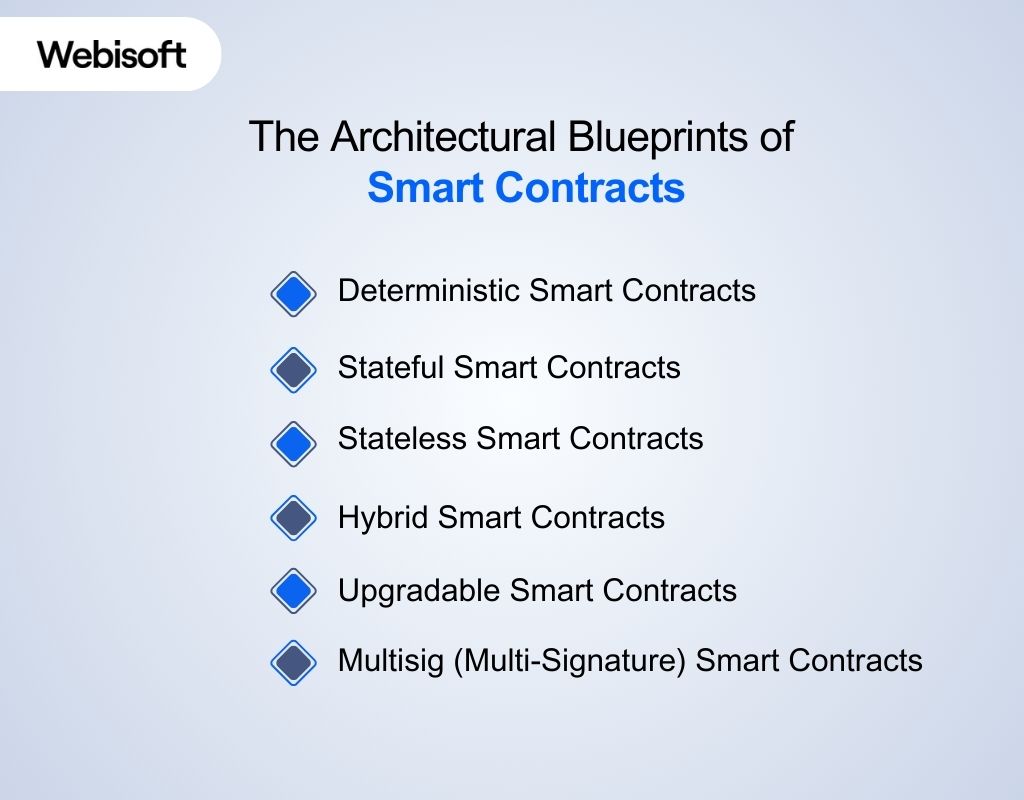 Smart contracts take different forms based on their purpose and the environments where they operate. Across industries, they simplify transactions, automate processes, and enable new digital interactions, leading to practical applications that continue to expand.
Deterministic Smart Contracts
Deterministic smart contracts execute predefined logic without relying on external data. Given the same inputs, they always produce the same output. These contracts are widely used for automated payments, escrow releases, and rule-based transfers.
Stateful Smart Contracts
Stateful smart contracts store data internally and update it over time. Each transaction changes the contract’s state. They are essential for applications like lending protocols, voting systems, and games where history and balances matter.
Stateless Smart Contracts
Stateless smart contracts do not store long-term data. They execute logic and return results without maintaining internal state. These are useful for validation checks, lightweight computations, and modular blockchain applications.
Hybrid Smart Contracts
Hybrid smart contracts combine on-chain code with off-chain data and computations provided by decentralized Oracles. While the contract remains secure on the blockchain, it can respond to real-world events.
These are widely used in crop insurance (payouts based on weather), supply chain tracking (updates based on GPS data), and dynamic NFTs that change based on external stats.
Upgradable Smart Contracts
Upgradable smart contracts use a proxy pattern to allow developers to modify their logic after deployment while keeping the original data and address intact.
This is achieved by separating the data storage from the execution logic. They are essential for complex DeFi protocols that require periodic security patches, feature updates, or optimization without migrating the entire user base.
Multisig (Multi-Signature) Smart Contracts
Multisig smart contracts require more than one digital signature, usually from a predefined group of authorized users, to execute a transaction.
This “M-of-N” logic ensures that no single person has total control over funds or governance. They are the standard for managing DAO treasuries, corporate fund security, and high-value asset management.
Functional Types of Smart Contracts in the Modern Economy
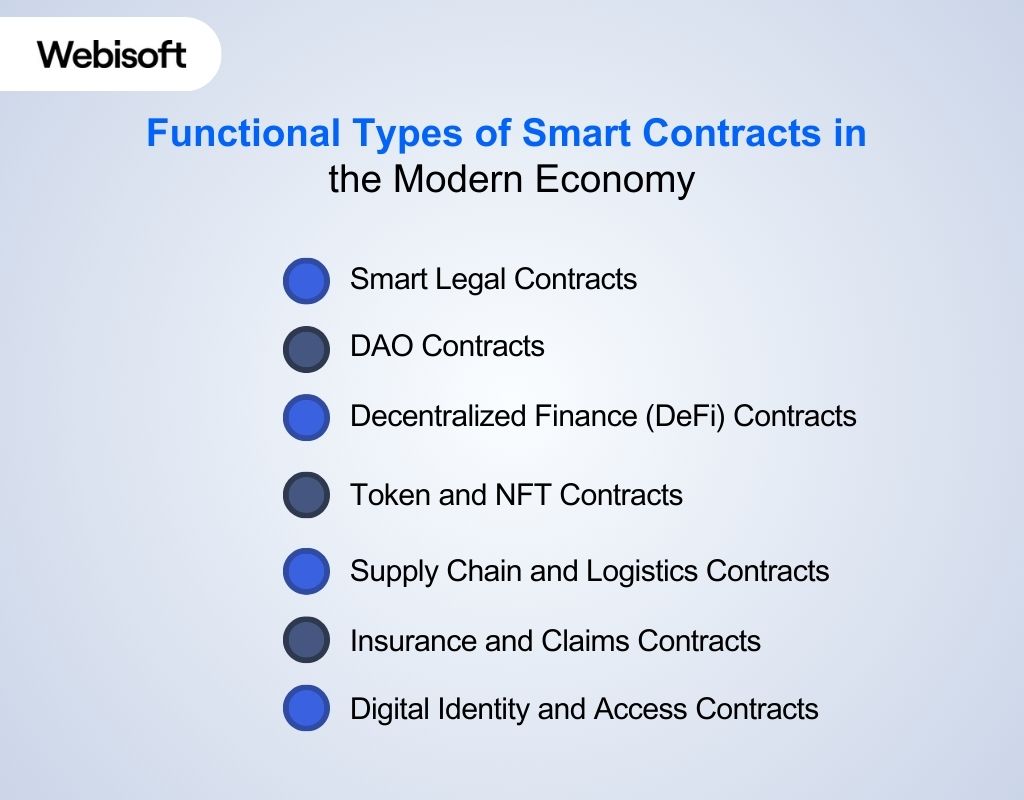 While technical structures define how a contract handles data, functional classifications determine how they solve specific industry challenges. In the modern economy, these contracts act as the digital backbone for everything from decentralized financial systems to global logistics networks.
By tailoring code to meet industry-specific rules, these functional types eliminate the need for traditional intermediaries and streamline complex business operations.
Smart Legal Contracts
Smart legal contracts combine traditional legal agreements with programmable logic. They automate specific obligations such as payments or confirmations. These contracts are often used in rentals, service agreements, and subscription-based models.
Decentralized Autonomous Organization (DAO) Contracts
DAO contracts define governance rules for decentralized communities. They automate voting, treasury management, and proposal execution. These contracts allow organizations to operate transparently without centralized control.
Decentralized Finance (DeFi) Contracts
DeFi smart contracts execute financial services entirely on-chain. They handle lending, borrowing, trading, and yield generation. These contracts form the backbone of decentralized exchanges and financial protocols.
Token and NFT Contracts
Token and NFT contracts define how digital assets are created and transferred. They manage ownership, supply limits, and transaction rules. These contracts support cryptocurrencies, NFTs, and digital collectibles.
Supply Chain and Logistics Contracts
Supply chain contracts automate tracking and verification across participants. They trigger updates or payments when milestones are met. Businesses use them to improve transparency and reduce operational delays.
Insurance and Claims Contracts
Insurance smart contracts automate claim validation and payouts. They execute only when predefined conditions are satisfied. Common uses include flight delay insurance and parametric risk coverage.
Digital Identity and Access Contracts
Digital identity contracts manage authentication and access permissions. They give users control over personal data sharing. These contracts are used in KYC processes, secure logins, and access control systems.


Build secure smart contracts with Webisoft today!
Book a consultation and start creating reliable blockchain solutions with ease
Blockchains That Support Smart Contract Creation and How They Differ
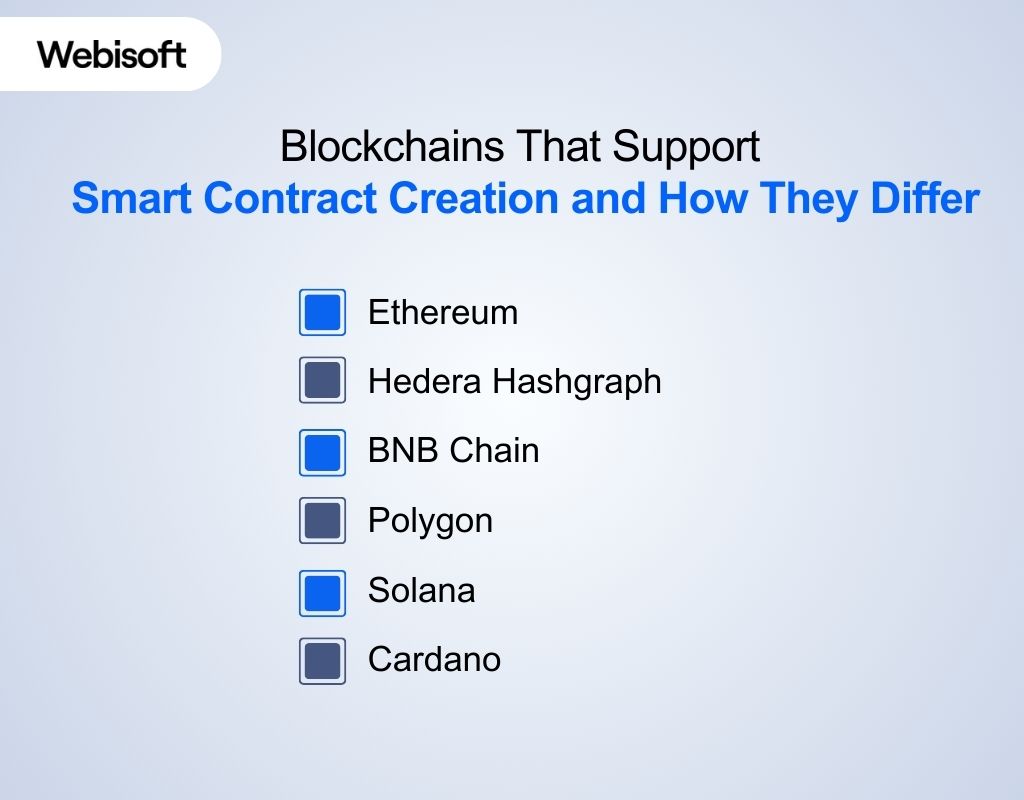 Smart contract platforms vary in speed, programming languages, fees, and security models. Since you’ve seen how smart contracts function and where they apply, comparing blockchain strengths helps you choose the most suitable platform for deployment today.
Ethereum (EVM-Based Networks)
Ethereum is the most established smart contract platform, using the Solidity language and the Ethereum Virtual Machine.
It offers the richest developer ecosystem, extensive tooling, and broad community support, making it the default choice for many decentralized applications and token standards. How it differs:
- EVM architecture with Solidity
- High decentralization but higher gas fees
- Largest tooling ecosystem
- Wide Layer 2 network support
Hedera Hashgraph
Hedera enables smart contracts through an EVM-compatible environment while using its unique Hashgraph consensus for speed and fairness.
It offers predictable low fees, fast finality, and enterprise-grade governance, making it suitable for applications needing consistency and high throughput. How it differs:
- Ultra-low transaction cost
- High-speed consensus with quick finality
- Not a blockchain but EVM-compatible
- Governed by global enterprises
BNB Chain (Binance Smart Chain)
BNB Chain provides a fast, cost-efficient environment for deploying Solidity-based contracts. Its EVM compatibility makes migration from Ethereum simple, and its performance appeals to teams building DeFi, gaming, and high-volume consumer applications. How it differs:
- Faster block times than Ethereum
- Lower execution fees
- Easy contract portability via EVM
- Less decentralized overall
Polygon (Layer 2 on Ethereum)
Polygon enhances Ethereum scalability by offering significantly lower fees and faster confirmations while maintaining full Solidity and EVM compatibility. It’s widely used by dApps that require high transaction throughput without leaving the Ethereum ecosystem. How it differs:
- Built on Ethereum’s security model
- Very low cost and high speed
- Fully compatible with Solidity
- Ideal for scaling existing dApps
Solana
Solana supports smart contracts through Rust and C-based languages and is engineered for extremely high throughput.
Its architecture allows thousands of transactions per second, making it suitable for complex, high-performance applications like advanced DeFi platforms and real-time on-chain systems. How it differs:
- Not EVM-compatible
- Exceptionally fast execution
- Different programming model
- Suited for high-frequency workloads
Cardano
Cardano uses Plutus and Marlowe to build smart contracts with a strong focus on security and formal verification. This makes it appealing for applications where correctness is crucial, although its ecosystem develops more slowly than EVM-based chains. How it differs:
- Uses Haskell-based contract languages
- Emphasis on formal proofs and security
- Slower but methodical development
- No Solidity or EVM compatibility
Programming Languages Used to Create Smart Contracts
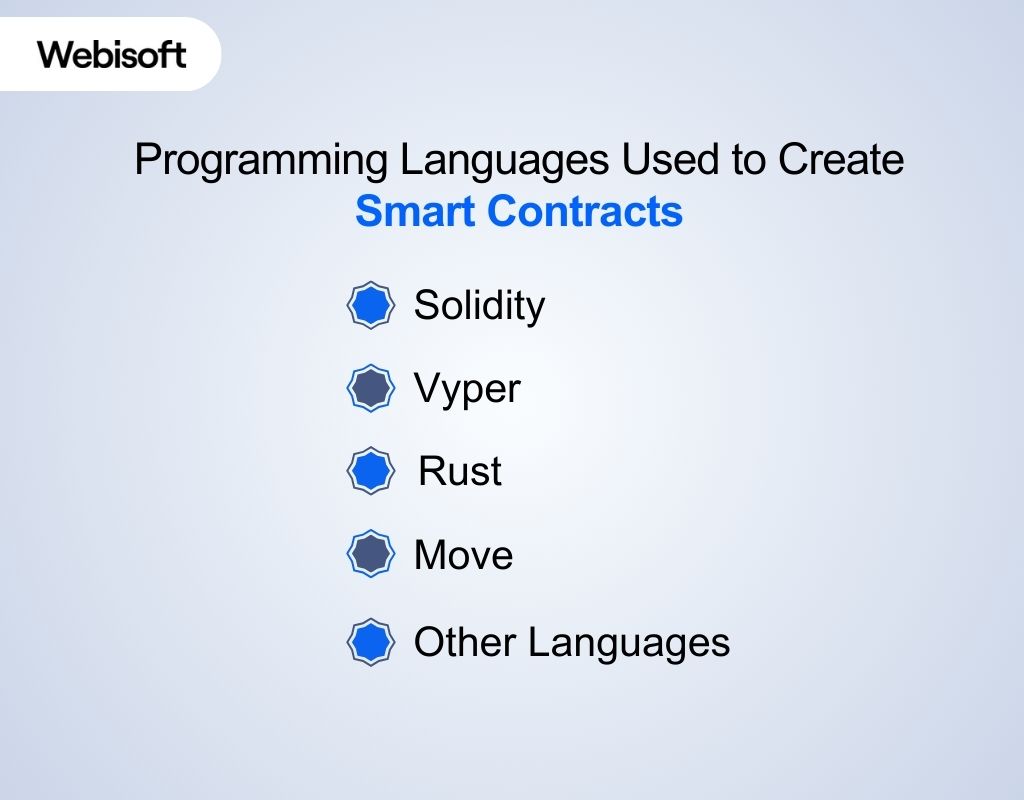 Smart contracts rely on specialized programming languages built for blockchain environments, each offering advantages in security, performance, or platform compatibility. Selecting the right language helps you write safer, more efficient contracts suited to your chosen blockchain.
Solidity
Solidity is the most widely used language for Ethereum and EVM chains. Its JavaScript-like syntax and object-oriented structure make it accessible for developers learning how to create a smart contract using solidity.
Vyper
Vyper is a security-focused Ethereum language with Python-like syntax and stricter rules. Its simplicity reduces common vulnerabilities, making it ideal for financial or audit-heavy contracts.
Rust
Rust powers smart contracts on Solana, Polkadot, and NEAR. Known for performance and strict memory safety, it is well suited for complex or high-throughput applications, though it requires entirely different tooling from EVM ecosystems.
Move
Move, used by Aptos and Sui, treats assets as protected resources. This prevents duplication or accidental loss, making it valuable for financial and asset-driven applications.
Other Languages
Cadence (Flow), Motoko (Internet Computer), and Ink! (Polkadot) offer ecosystem-specific features that optimize performance and safety within their respective platforms.
Tools You Need Before You Start Creating a Smart Contract
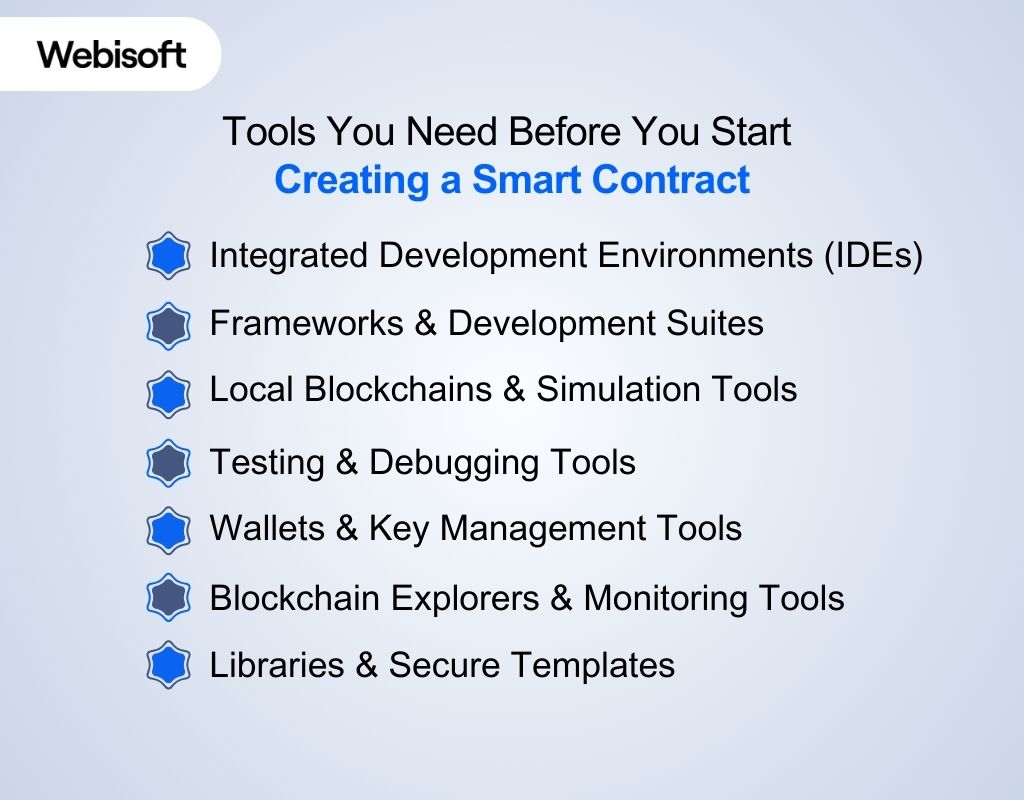 Smart contract development involves more than writing code. You need tools to write, test, simulate, deploy, debug, and monitor your contract across its entire lifecycle. The right setup speeds development, improves accuracy, and strengthens security before mainnet deployment.
Integrated Development Environments (IDEs)
IDEs like Remix IDE offer syntax highlighting, error checks, and browser-based coding environments customized to Solidity, making development more intuitive.
Frameworks & Development Suites
Hardhat, Truffle, and Embark provide structured workflows for compiling, testing, and deploying contracts, along with built-in utilities and local networks.
Local Blockchains & Simulation Tools
Ganache lets you run a private blockchain for quick, cost-free testing and iteration before deploying to real networks.
Testing & Debugging Tools
Tools such as Truffle’s test runner, Hardhat plugins, and OpenZeppelin Test Helpers verify contract logic and reduce errors early.
Wallets & Key Management Tools
Wallets like MetaMask are essential for signing transactions, managing testnet or mainnet funds, and supporting setups used when learning how to create a smart contract wallet.
Blockchain Explorers & Monitoring Tools
Etherscan and similar explorers allow you to track deployments, review transactions, and monitor live contract activity.
Libraries & Secure Templates
OpenZeppelin’s audited libraries (ERC-20, ERC-721, etc.) provide secure modules that reduce development time and lower security risks.
How to Create a Smart Contract From Scratch
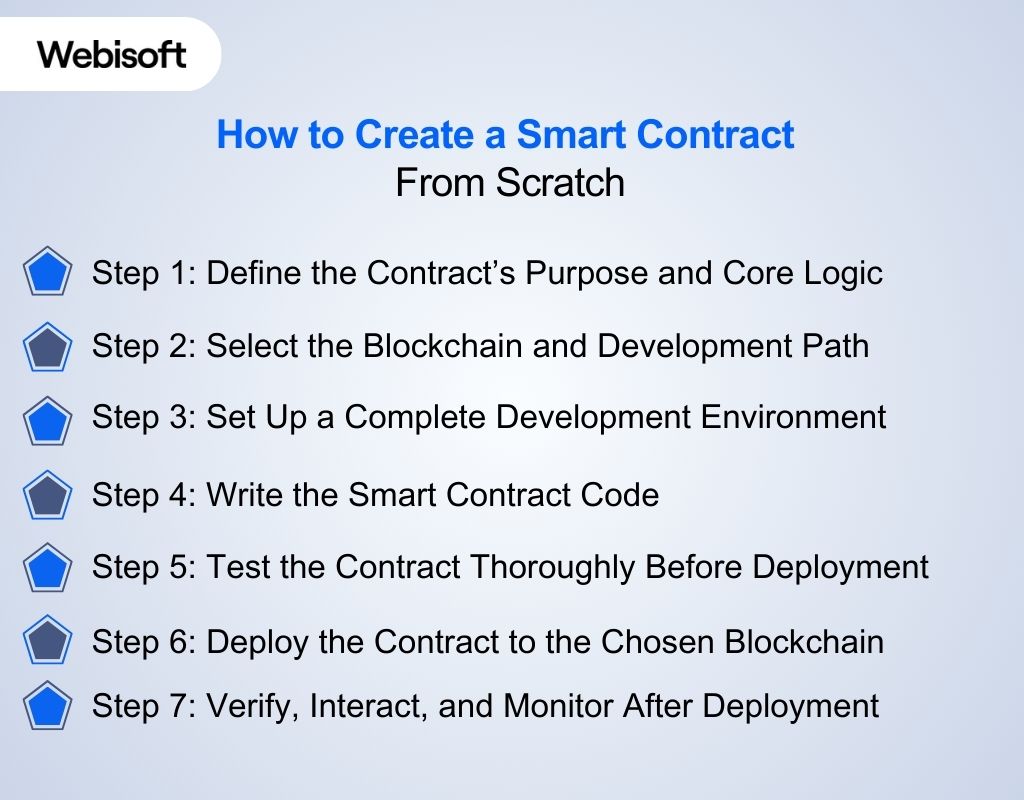 Smart contract creation follows a clear development flow from defining requirements to deploying a working contract.
Understanding how to create a smart contract using blockchain helps you apply earlier concepts, tools, and platform choices more effectively as you begin building.
Step 1: Define the Contract’s Purpose and Core Logic
Begin by identifying what your smart contract must accomplish. This includes the rules it should enforce, the conditions that trigger actions, and the outcomes that users expect. Clearly outlining the purpose helps prevent logical errors later in development. Key considerations:
- What inputs should trigger an action?
- What outputs or state changes must occur?
- Are there failure conditions requiring safeguards?
A well-structured purpose ensures the contract’s behavior remains predictable once deployed.
Step 2: Select the Blockchain and Development Path
Your chosen network determines the language, tooling, transaction cost, and performance characteristics of your contract.
Ethereum remains the most common choice, though alternatives like Polygon, BNB Chain, Solana, and Hedera offer different benefits depending on your use case.
If you prefer a simplified workflow, no-code platforms now allow you to Create smart contract without coding, making development accessible even without programming skills. When choosing a blockchain, evaluate:
- Gas fees and network costs
- Throughput requirements
- Compatibility with required libraries
- Ecosystem maturity and community support
Step 3: Set Up a Complete Development Environment
A proper development environment gives you the tools needed to write, compile, deploy, and test your contract safely before it reaches the mainnet.
This setup typically includes a code editor, a node provider, a wallet, and a local blockchain simulator. A typical setup includes:
- Visual Studio Code or another preferred editor
- Hardhat or Truffle for development automation
- Ganache for local blockchain simulation
- MetaMask or another wallet for signing deployments
- Access to testnets via RPC providers
This foundation builds a stable workflow for development and debugging.
Step 4: Write the Smart Contract Code
With your environment ready, you can begin writing the contract in a language supported by your platform, such as Solidity, Vyper, Rust, or Move.
Focus on translating your defined logic into secure and efficient code while using audited libraries whenever possible. You can follow a structured Smart contract tutorial to improve learning and apply best practices.
And enhance your development approach with support from official smart contract documentation for clarity. Best practices while writing code:
- Keep functions modular and readable
- Use events for tracking state changes
- Follow secure design patterns (check-effects-interactions)
- Avoid unnecessary complexity that increases gas usage
Once written, compile the code to detect syntax or type errors before testing.
Step 5: Test the Contract Thoroughly Before Deployment
Testing is critical because smart contracts are immutable once deployed. Use local environments like Ganache and automated scripts to simulate interactions and evaluate contract behavior under various conditions. Testing checklist:
- Validate normal user flows
- Check edge cases and invalid inputs
- Test error handling and reverts
- Simulate high-volume interactions (if relevant)
Comprehensive testing helps prevent costly issues on the mainnet.
Step 6: Deploy the Contract to the Chosen Blockchain
When testing is complete, deploy your contract to a testnet or directly to the mainnet. Deployment requires compiling the bytecode, signing the transaction with your wallet, and broadcasting it to the network. Considerations during deployment:
- Ensure sufficient balance for gas fees
- Double-check constructor parameters
- Verify that the deployment address is correct
- Record the contract address for future interactions
Deployment effectively makes your contract publicly available and usable.
Step 7: Verify, Interact, and Monitor After Deployment
After deploying, verify your contract on explorers like Etherscan or Polygonscan so users can review the source code. This adds transparency and builds trust.
Next, test interactions with the live contract through scripts, user interfaces, or direct wallet calls to ensure behavior matches your expectations. Ongoing monitoring includes:
- Checking for performance bottlenecks
- Observing gas usage
- Tracking events and logs
- Ensuring the contract behaves consistently in real-world scenarios
This final step ensures your smart contract remains reliable and stable in production.
How to Create & Deploy a Smart Contract on Specific Platforms
Smart contract deployment varies across different blockchain ecosystems, and understanding each platform’s workflow helps you translate general development steps into real execution. Below are the practical solutions on how to create a smart contract on the four most widely used networks.
Ethereum (Remix + Hardhat)
Ethereum offers the most mature environment for writing and deploying smart contracts, with tools like Remix and Hardhat simplifying everything from coding to verification. This structured workflow shows how to create a smart contract Ethereum and is commonly used to deploy smart contract ethereum solutions for secure, production-ready decentralized applications.
- Write the contract in Solidity using Remix or Hardhat.
- Compile the contract and fix any warnings or errors.
- Connect MetaMask and select a suitable Ethereum testnet or mainnet.
- Fund your wallet with ETH to cover deployment gas fees.
- Deploy the contract through Remix or by running a Hardhat deployment script.
- Wait for the transaction to confirm and retrieve the contract address.
- Verify the deployed contract on Etherscan for transparency and accessibility.
Polygon
Polygon uses the same EVM architecture as Ethereum, making deployment familiar while offering lower fees and faster confirmations. Developers often choose it for scalable consumer-facing or low-cost applications.
- Write and compile your Solidity contract in Remix or Hardhat.
- Configure Polygon RPC settings within your deployment tool.
- Connect MetaMask to the Polygon testnet or mainnet.
- Add MATIC to your wallet to pay for transaction fees.
- Deploy the compiled contract through Remix or a Hardhat deployment script.
- Confirm the transaction and obtain the deployed contract address.
- Verify the contract on Polygonscan to display the source code publicly.
BNB Chain
BNB Chain is a fast, EVM-compatible network widely used for DeFi, gaming, and high-volume applications. Its low fees and short block times make deployments efficient and cost-effective.
- Prepare your Solidity contract using Hardhat or Remix.
- Add the BNB Chain RPC endpoint and chain ID to your wallet or tool configuration.
- Connect MetaMask to the testnet or mainnet environment.
- Ensure your wallet holds BNB to cover deployment gas.
- Deploy using Remix or by running a Hardhat script tailored for BNB Chain.
- Wait for block confirmation and note the contract address.
- Verify the contract on BscScan to enhance trust and visibility.
Solana (Rust + CLI)
Solana follows a completely different model compared to EVM chains. Smart contracts, known as programs, are written in Rust and deployed through the Solana CLI, making the workflow suitable for high-performance applications.
- Write the program in Rust following Solana’s program architecture.
- Install and configure the Solana CLI and developer toolchain.
- Build and compile the program into a Solana-compatible binary.
- Create or connect a Solana wallet (such as Phantom) to manage deployment.
- Fund your wallet with SOL to cover deployment fees.
- Deploy the compiled program using Solana CLI commands.
- Save the program ID generated upon deployment for later interactions.
- Interact with the program using client-side code or scripts rather than EVM-style calls.
How to Test a Smart Contract Properly Before You Create a Production Deployment
Testing ensures your smart contract behaves reliably before production. Since deployed contracts are hard to change, validating every action early prevents failures, security risks, and logic errors.
Unit Testing Smart Contracts
Unit tests check individual functions under different conditions. By isolating each part, you catch logic issues early. Tools like Hardhat, Truffle, and Foundry simulate calls and state changes for accurate validation.
Automated Test Suite Execution
Automated suites run tests repeatedly, ensuring updates don’t break existing features. Integrated test runners help detect failures, track behavior, and maintain long-term reliability.
Integration Testing Across Components
Integration tests examine how your contract interacts with others. Simulated workflows and user journeys reveal issues unit tests may miss, especially in multi-contract dApps.
Security and Vulnerability Testing
Security tests identify high-impact risks. Tools like Slither, MythX, and Echidna scan for vulnerabilities, while manual reviews catch deeper logic flaws.
Performance and Gas Optimization Testing
Performance tests measure efficiency and gas usage. Analyzing costly operations and simulating network conditions helps optimize speed, reduce fees, and ensure consistent behavior.
Creating smart contracts becomes far more efficient with expert guidance and a refined development approach. Connect with Webisoft to simplify your build process, strengthen security, and move from concept to deployment with clarity and confidence.
Security Practices You Must Follow While Creating a Smart Contract
Security is one of the most important aspects of smart contract development because once deployed, code is immutable and accessible to all. Following best practices helps prevent exploits, unauthorized access, and costly vulnerabilities before go-live.
- Use Audited Libraries and Standards: Rely on battle-tested frameworks like OpenZeppelin to avoid reinventing core functionality and reduce risk.
- Follow Secure Coding Patterns: Adopt patterns such as checks-effects-interactions and avoid unsafe constructs to minimize known vulnerabilities.
- Perform Thorough Testing: Combine unit, integration, and edge-case tests to validate logic and catch security issues before deployment.
- Run Static and Dynamic Analysis: Use tools like Slither, MythX, and Echidna to detect common flaws and unexpected behavior.
- Limit Privileged Access: Restrict roles and permissions, and implement multisignature controls where possible.
- Plan for Upgradeability Carefully: If using proxies, design upgrade mechanisms with strong governance and security audits.
- Prepare a Response Strategy: Have incident handling, bug bounty, and patching plans ready before deployment.
How Webisoft Helps With Smart Contract Creation
 Turning smart contract concepts into real, dependable systems takes more than code. It takes a partner who understands vision, scalability, and execution. Webisoft steps in with craftsmanship and clarity, helping you build blockchain experiences that truly work in the real world.
Smart Contracts Built Around Your Vision
Webisoft takes time to understand the logic behind your vision, then turns it into a secure, scalable smart contract that works exactly the way your business needs it to. Whether you prefer Solidity, Rust, or Vyper, our team builds audit-ready contracts and deploys them across platforms like Ethereum, Solana, or Hedera with precision and care.
End-to-End Blockchain Development for Your Product
When your idea goes beyond a single contract, Webisoft steps in as a full blockchain development partner. We design and build entire blockchain ecosystems, from dApps to custom networks, ensuring every component works seamlessly. You get a solution shaped around your goals, not a generic template.
Wallets and Tokens Designed for Your Users
If your project needs a wallet or token system, Webisoft creates tools that feel intuitive for your users and secure for your business. Our wallet and token builds include multi-currency support, robust authentication, and smooth transaction workflows. Thus giving your product the polished experience it deserves.
Guidance That Matches Your Strategy and Goals
Instead of leaving you to figure things out alone, Webisoft guides you through every strategic decision, from choosing the right blockchain to structuring your architecture.
Our consulting ensures you invest in the right solutions, avoid unnecessary complexity, and move forward with confidence at every stage.
Enterprise Blockchain Solutions Built for Your Growth
For larger organizations, Webisoft designs enterprise blockchain systems that can evolve with your operations. Whether you need private chains, enterprise smart contracts, or cross-chain communication, we build solutions that stay resilient under pressure and flexible enough to support long-term growth.
Build secure smart contracts with Webisoft today!
Book a consultation and start creating reliable blockchain solutions with ease
Conclusion
Once you understand how to create a smart contract, the technology stops feeling like blockchain magic. It starts looking like a practical tool you can shape to fit real problems.
With the right structure, testing, and deployment approach, these self-executing agreements become powerful building blocks for anything from payments to full-scale applications.
And when your ideas grow beyond experiments, partnering with specialists matters. Webisoft helps you turn early concepts into secure, polished smart contracts built for real-world use and long-term reliability.
Frequently Asked Question
Do smart contracts use AI?
No, smart contracts don’t use AI by default. They execute predefined rules exactly as coded. However, AI can work alongside smart contracts through external data feeds or off-chain processing, but the contract itself remains deterministic and non-adaptive.
How much does it cost to create a smart contract?
The cost varies widely depending on complexity, required security audits, and the blockchain used. Simple contracts may cost a few hundred dollars, while complex or enterprise-grade contracts can require significantly higher investment, especially when professional development and auditing are involved.
How long does it take to create a smart contract?
A basic smart contract can be created in a few hours, while more advanced, multi-function contracts may take days or weeks. Factors include testing, security reviews, platform selection, and integration needs before deployment to a production environment.
